
When your jobsite needs a dedicated workspace but traditional construction isn't practical, you have two prefab options — portable office trailers and modular office buildings. Both deliver functional workspace faster than conventional builds, but they're designed for different scenarios.
Choosing between them comes down to five site-specific factors — project duration, mobility requirements, setup speed, budget constraints, and feature priorities. By understanding how each option performs across these dimensions, you can select the solution that keeps your crew productive, your timeline on track, and your project budget intact.
A portable office trailer is an office with a hitch and wheels that you can easily relocate by truck. It arrives ready to use and can move with your crew wherever they work.
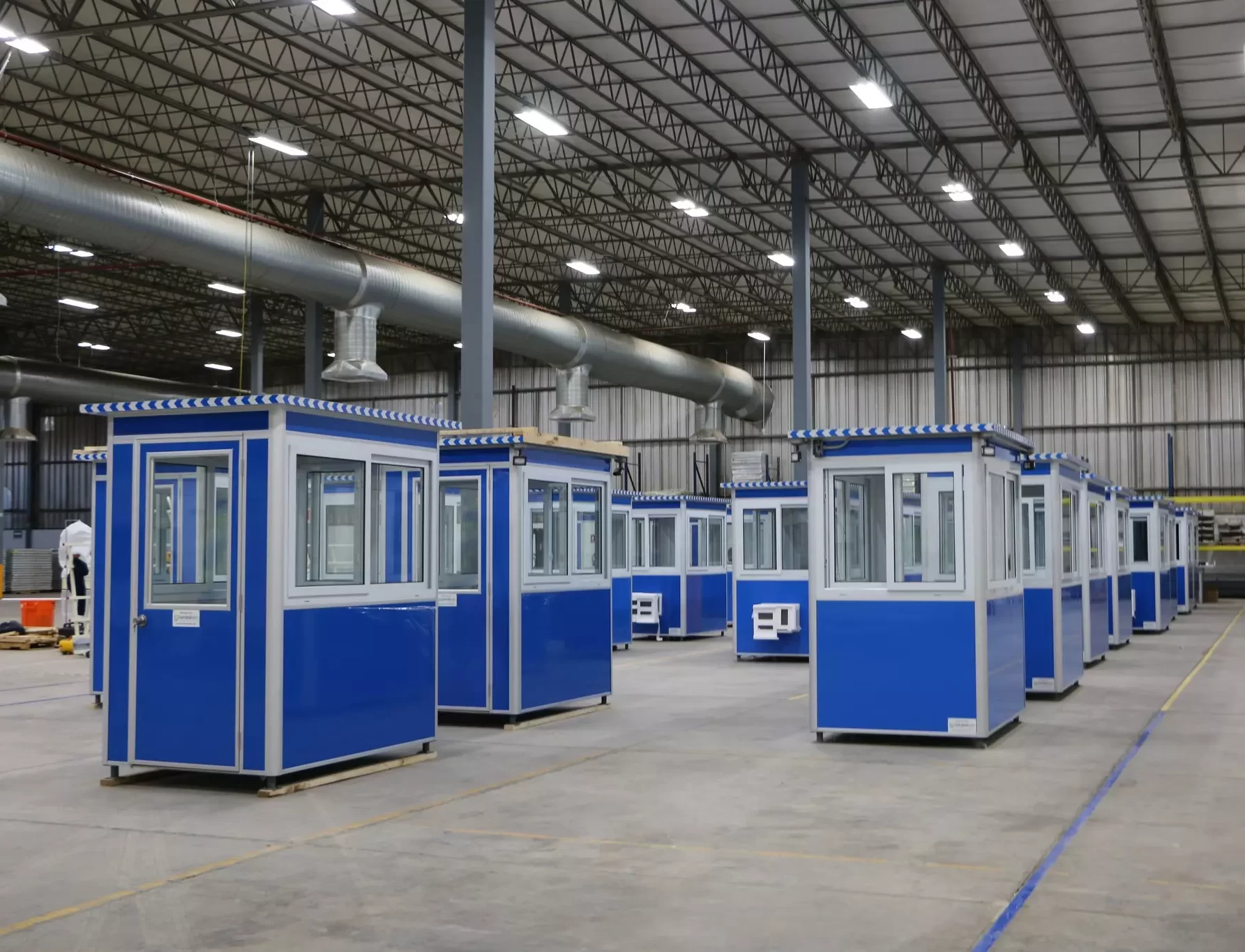
A modular office, by contrast, looks and operates more like a permanent building. Many businesses use modular buildings for offices, crew break rooms, conference rooms, and even clean rooms. Manufacturers customize the interior finishes, mechanical systems, and layouts of modular units to reduce on-site construction time, delivering a solution with shorter build times than traditional construction.
The table below highlights the key differences between these two workspace solutions for a quick comparison.
| Feature | Portable Office Trailer | Modular Office Building |
| Mobility | High — towed by truck for easy relocation | Moderate — relocatable with advance planning |
| Best for | Short-term or mid-term projects | Long-term or semipermanent use |
| Sizes | 4×4, 4×6, 6×6, 6×8, 8×10, or fully custom | 4×4, 4×6, 6×6, 6×8, 8×10, or fully custom |
| Mounting | Trailer-mounted | Surface-, caster wheel-, or skid-mounted |
| Setup time | Ready to use upon delivery | Preparation for mounting and utilities |
| Up-front costs | Lower entry point | Higher up-front cost, better long-term value |
| Customization | Climate control, layout, branding, and more | Numerous customization options |
| Lead time | Standard sizes: Two weeksCustom builds: Eight to 12 weeksComplex builds: 16+ weeks | Standard sizes: Two weeksCustom builds: Eight to 12 weeksComplex builds: 16+ weeks |
Choosing between a portable office trailer and a modular office depends on your specific operational requirements. Ask yourself the following five questions to evaluate which option is right for your project.
Short-duration projects that are roughly under a year typically favor a trailer. Consider a road construction crew managing a highway resurfacing project that will wrap up in six months. This short-term project will benefit from the trailer's mobility and lower entry cost.
Longer or open-ended projects tend to favor a modular structure. A prime example is a healthcare provider that is setting up a clinic in a rural community. With no fixed end date and the possibility of adding more units as patient volume grows, the company gains better long-term value from a modular unit.
If your site is fixed, you can opt for either a trailer or a modular office. However, if your crew relocates between phases or sites, a portable trailer wins on pure practicality — it's built to move. For example, a utility company managing power line installation across several counties can roll the same site office from one jobsite to the next.
You can also relocate modular offices, but it takes more time than moving a wheeled trailer. They're more ideal when your workspace stays in place for the duration of your project.
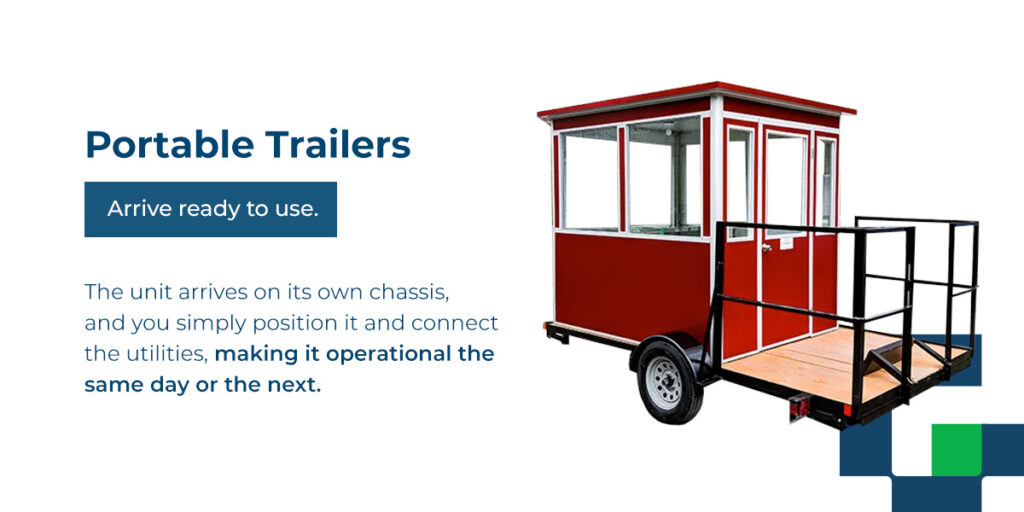
Portable trailers arrive ready to use. The unit arrives on its own chassis, and you simply position it and connect the utilities, making it operational the same day or the next.
Modular offices require more on-site coordination. The unit arrives fully assembled, but if you want to surface-mount it, you will need a prepared concrete or asphalt pad. If skid-mounted, the setup timeline is a bit faster.
Lead time also matters. Before purchasing a unit, consider the manufacturer's lead time. Guardian Prefab, for example, has a Quick Ship program that delivers portable trailers or modular booths in standard sizes within two weeks. Custom configurations take eight to 12 weeks, and more complex builds require 16+ weeks.
Portable trailers generally have lower entry costs, making them practical for projects with tighter budgets or shorter timelines. Modular offices require more up-front investment but deliver better long-term value if you use the space for an extended period.
However, both options are more cost-effective than traditional construction. In fact, modular construction can reduce costs by up to 20% compared to traditional construction methods.
Each business is unique and requires specific features to enhance productivity and worker safety. A remote mining operation might need reliable climate control and power generation, while a construction site entrance needs branding, a security window, and a key management system.
Before selecting a unit, identify which features are nonnegotiable for your project. Both portable office trailers and modular office buildings offer extensive customization options.
Add-ons for portable office trailers might include:
Modular office booths might have the following customization options:
The right choice depends on matching a workspace solution to your project's operational realities.
Choose a portable office trailer if:
Choose a modular office if:
ADA requirements can vary by state and municipality, so it's always a good idea to check local building codes in addition to federal standards. In some cases, a standard trailer is fine for a short-term jobsite with no public access. For example, office trailers for construction sites usually do not need to comply with ADA requirements under Section 203.2.
For anything longer-term, customer-facing, or in a semipermanent setting, a modular building with full ADA features is the safer and more practical choice. These compliant features include wheelchair accessibility, accommodating doorways, accessible restrooms, and desks and countertops that meet ADA criteria.
You can now choose between a portable office trailer and a modular office based on your jobsite's unique requirements. Guardian Prefab offers both solutions under one roof, plus a full range of add-ons, including HVAC systems, Ethernet ports, and ADA-compliant ramps.
Ready to move forward? Explore portable office trailers or modular office options to see standard configurations and customization features. You can also contact Guardian Prefab directly to work with a designated account manager who will guide you through the selection process, ensuring you get the workspace solution that fits your site, timeline, and budget.